In my last two blogs, “Abortion: Pro-Life/Pro-Choice Both Right?”
and “Abortion: Why Both Sides Will Lose in the Supreme Court (Again)” I
explained why the 1973 Roe v. Wade decision was not a clear win for either
pro-choice or for pro-life supporters and why I thought that both sides would
once again be disappointed if a modern Supreme Court consented to review the
case.
But while my reading of the Supreme Court’s Roe v. Wade
decision, modern medicine, and our current political climate lead me to believe
that a review of Roe would not be substantially different than it was in 1973,
I do think that there are compelling reasons that argue for a dramatic change. Instead of beginning with biblical,
theological or doctrinal reasons (which I obviously have), let’s begin with
reason and logic.
As I have explained, Roe v. Wade was a decision that
attempted to find a balance between two rights guaranteed by the Constitution,
a right to privacy on the part of the mother, and a right to life on the part
of the infant. In my reading of the
court’s ruling, it seems that there was never a question that both rights
existed and the both deserved to be protected.
The question was, if two rights are in conflict, which has a superior
claim and when (or if) does that superiority change? I have a right to privacy in my own home, but
if I were to commit criminal acts, particularly those that harmed other human
beings, my right to privacy is superseded by the other person’s right to life
and liberty. This delineation is well
accepted as both moral and legal. This
same question, when brought into the realm of abortion, becomes a question of
a) is a pre-born infant a human being, and if yes, b) when does it become one? The Supreme Court answers to these questions
in 1973 were a) yes, and b) at the earliest point at which the infant is viable
(with medical intervention).
In 1973 the womb was something of a “black box.” We knew that an infant developed in the
mother’s womb and developed from a fertilized egg, we had all sorts of microscope
slides and fetuses in jars that had been aborted at various stages of
development. What we didn’t have were
the spectacular images that we have today.
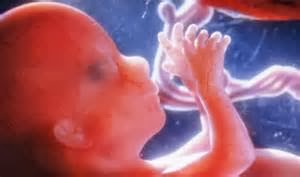
Today expectant parents can sit in the office of their OB/GYN and see
live 3D images of their child. They can
see that preborn infant scratch its nose, cough, sneeze, and suck its thumb. So real are these images, that 78%
of women who were considering abortion changed their minds after they had
seen them.
I’m not saying we were ignorant in 1973 and we are now
“enlightened,” but what we know and what we have learned, seem to make it much
harder to draw a line in the sand and say that “this” is a person with Constitutional
rights, and a moment earlier “that” was not a person. Does an infant become a person because it’s
larger than it was yesterday? If so, do
tall people have more rights than short people, or do adults have a stronger
right to life than children? Does it
suddenly become a person because it is no longer in the womb? The human rights of any other “person” do not
change based on location. A person in
Detroit, Michigan has no more or less rights than a person in rural China. Location cannot, logically, convey basic
human rights or take them away. Is a
preborn infant not a person because it is dependent upon its mother? If so, then do adults on life support
surrender their right to life? We are
all, in one way or another, dependent upon others for our lives. Simply because an infant needs its mother
cannot imply that it somehow has fewer rights than an infant only days or weeks
older. At other times in history, groups
of people were declared a separate “class” of human being so that their rights
could be denied, Jews, Gypsies, Blacks, and others. Can we, in good conscience, declare a group
of human beings, with measurable human DNA, to be a separate “class” of humans
that are not entitled to human rights?
Biblically speaking, we know that God loves all of his
children equally. All human beings are
of sacred worth. The redemption of every
person on earth was purchased by Jesus Christ at the cost of his own life. We cannot gamble that God cares more about an
infant more today, simply because yesterday it was in the womb and today it is
not, or because today it is one day older than yesterday.
I have heard various arguments from the position that Old Testament
references did not consider an infant to be a “person” under the law until
after it was born. While this is
arguable on a number of points, it assumes that people who lived four thousand
years ago could have known any differently.
Asking this question would seem to place an unfair moral burden on
ancient cultures. How would any culture
with little understanding of fetal development, no ability to detect a fetal
heartbeat, no ultrasound, and no modern medical understanding of neural development
have fairly ruled that a preborn infant is equal to one who independently draws
breath? Their decision on personhood
was, much as it was in 1973, based upon viability.
Please understand that I value my privacy as much or more
than anyone, but regardless of my feelings or personal opinion, privacy has
always taken a backseat to more important rights, and the right to life is
among these. Legally, I understand that
declaring an infant to be a person too early can create other difficulties,
such as the potential for criminal investigations against women who have
miscarriages and certainly I understand those who struggle with knowing at what
point an infant ought to be considered to be a person, especially in the
earliest stages of development. For me, however, I have few such doubts. I believe that morals, logic and scripture declare
in chorus that an infant is a person, and if an infant is a person at any point,
it must be one from the very beginning.
To me, these arguments seem reasonable and logically sound. If you can find error in the logic, I am interested in hearing your viewpoint.
-----------
Next: Problems with an Early Definition of Life
(Go back to the beginning - “Abortion: Pro-Life/Pro-Choice Both Right?”)
(Go back to the beginning - “Abortion: Pro-Life/Pro-Choice Both Right?”)